Between January and September 2026, I led the upgrade of an editorial application’s rich-text editor from CKEditor 5 v26 to v47.3: about 55 in-house plugins, 53 sub-PRs and 683 files. Here is what we learned, from the bare-editor strategy to the bugs only real typing revealed, the AI tooling that made it repeatable, and the two CKEditor issues it led to.
Structured data and guides are copyable in a weekend. The corpus behind your prices is not. How I turned thousands of hand-typed listings into a dated, sourced median a machine can cite — and the monthly routine that keeps it honest.
At work I’m running a CKEditor 5 migration from v26 to v47 across some twenty in-house plugins. Instead of tracking it all by hand, I wrote ckeditor_audit: a read-only MCP server that sorts every plugin into four migration statuses, flags what’s live in production, searches the code with ripgrep + ast-grep, and cuts the AI token bill by 80 to 95%.
Composable Claude Code skills turned a pile of unreviewed real-estate listings into a repeatable pipeline: one skill reviews a single listing, another loops over a site, a third fans out across all sites — each with its own guardrails and an audit gate before anything publishes.
How I built a schema-driven MCP server that lets an AI assistant manage many heterogeneous WordPress sites through a single typed interface — architecture, trade-offs and lessons learned.
A practical guide to making WordPress content AI-ready with JSON-LD, llms.txt and FAQ schema — what each signal does, how to ship them safely, and why accuracy beats volume.
A deep dive into project_search — a 25-tool MCP server built on ripgrep and ast-grep that cuts code search token costs by up to 99%. Learn the engineering decisions, token economy principles, and five lessons for building your own MCP server.
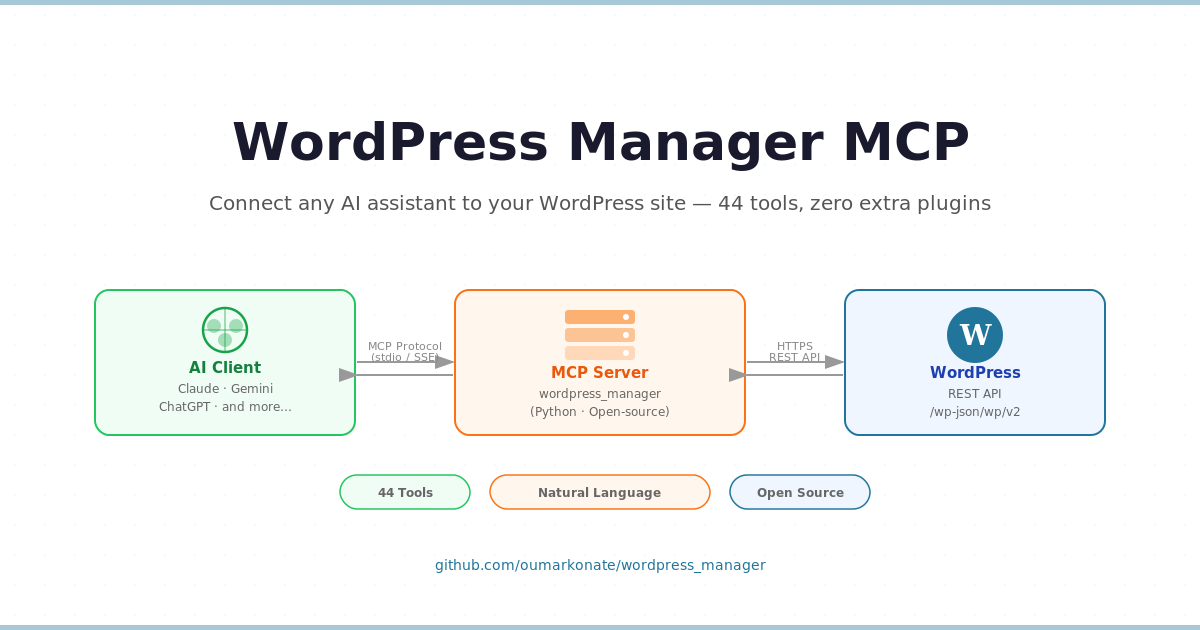
WordPress Manager MCP is an open-source server that lets any MCP-compatible AI assistant (Claude, Gemini, ChatGPT…) manage your WordPress site in natural language — 44 tools, no extra plugins required.